Hot in the media – Media Watch
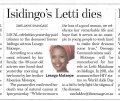
Soapie star’s passing should spark debate around HIV treatment
Media should highlight the efficacy of life-saving HIV treatment in the wake of soapie star Lesego Motsepe’s passing.
Lesego Motsepe became a positive role model for countless South Africans when she announced on radio that she was living with HIV on World AIDS Day two years ago. But at the beginning of 2012, Motsepe would make another very public and very controversial announcement reminiscent of the bogus ‘HIV treatment’ advocated by the late Health Minister Manto Tshabala-Msimang; Motsepe was stopping HIV treatment in favour of more natural methods.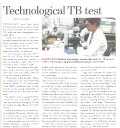
Communicating the ‘why’ helps readers identify
An article in The New Age brings critical advances in TB diagnostics to the fore but is somewhat unsuccessful in communicating ‘the why’ of the story, or the importance of the issue, to the reader.
Last week an article in The New Age (30 July 2013) effectively communicated the important role that Tuberculosis (TB) diagnostics play in curbing the spread of the disease and the benefits of the new GeneXpert technology.
However the crucial ‘why’, which conveys the significance of these advancements to the reader, is left to the end of the article.
HIV reporting needs to be concise, captivating & cover crucial issues
It is critical that HIV reporting strives to be topical, innovative and interesting in the context of ‘HIV fatigue’ and a decline in the perceived newsworthiness of HIV.
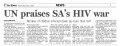
Last week The Star (31 July 2013) and The Times (31 July 2013) focused on a United Nations report, '2013 Getting to Zero: HIV in Eastern & Southern Africa'. The articles reported on the glowing review South Africa received for the “extraordinary progress” it has made in its response to HIV.
Whilst it is important to point out the substantial headway being made in response to HIV, therefore keeping HIV in the news and on the public’s radar, it is necessary to do so in a way that keeps the public’s attention and focuses on the key issues at hand.
Empowering coverage on PEP
Recent media coverage on rape provides readers with valuable information around HIV-preventative post-exposure prophylaxis (PEP). Articles in the Sowetan and Bona magazine have, in a refreshing change of pace, have included PEP when covering sexual assault, shedding much-needed light on the issue. According to a report in the Mail&Guardian last year, rape survivors are often left in the dark when it comes to post-rape care, which includes accessing and taking PEP. The media could fill this gap, acting as a vehicle for education and empowerment, and yet PEP is often still left out of post-rape care reporting.
HIV piggybacks onto the front page
When it comes to making front page news HIV may not always seem newsworthy on its own but it certainly does add to the news value of other more newsworthy stories.
Last week’s most prolific HIV-related news story had to be the pending trial and subsequent police-holding-cell suicide of alleged serial rapist Sifiso Makhubo.
It is a complete no-brainer that it was not the HIV aspect of this story that landed it on the front page of multiple newspapers, because while HIV-related stories do make it into our papers they seldom make the front page purely on their own steam.
In fact another high-profile HIV-related story that earned a spot on the front page last year was the lurid twist in the Eugene Terre’Blanche murder trial, where one of the accused alleged that Terre’Blanche had raped him and infected him with HIV.